
A video production company is a professional team that plans, films, and edits video content for brands, businesses, and organizations. Unlike hiring a solo videographer, a production company brings a full crew, specialized equipment, and a structured process — from creative concept to final delivery — to produce video that performs across YouTube, social media, broadcast, and beyond. This guide covers everything marketing directors and small business owners need to hire the right partner in 2025.
Whether you’re launching a brand film, producing social media ads, or documenting a live event, choosing the wrong production partner costs you time, money, and missed deadlines. This guide walks you through every stage of the process — what to budget, what to ask, and what to watch out for — so you can make a confident, informed decision.
This article is written specifically for marketing directors managing brand campaigns and small business owners investing in professional video for the first time. By the end, you’ll know exactly how to evaluate vendors, write a creative brief, and measure your return on investment.
Table of Contents
- What a Video Production Company Actually Does (Beyond Pointing a Camera)
- Types of Video Production Services and Which One Your Brand Needs
- Brand and Commercial Video
- Social Media and Short-Form Video
- How to Evaluate a Video Production Company: 7 Questions to Ask
- Video Production Pricing: What Does It Actually Cost in 2025?
- Hidden Costs to Watch Out For
- The Video Production Process: A Week-by-Week Timeline
- Where Your Video Will Live: Distribution Platforms and Format Requirements
- How to Measure ROI From a Video Production Investment
- Red Flags: Signs a Video Production Company Isn’t Right for You
- Next Steps: How to Brief a Video Production Company Like a Pro
- Glossary
- FAQ
What a Video Production Company Actually Does (Beyond Pointing a Camera)
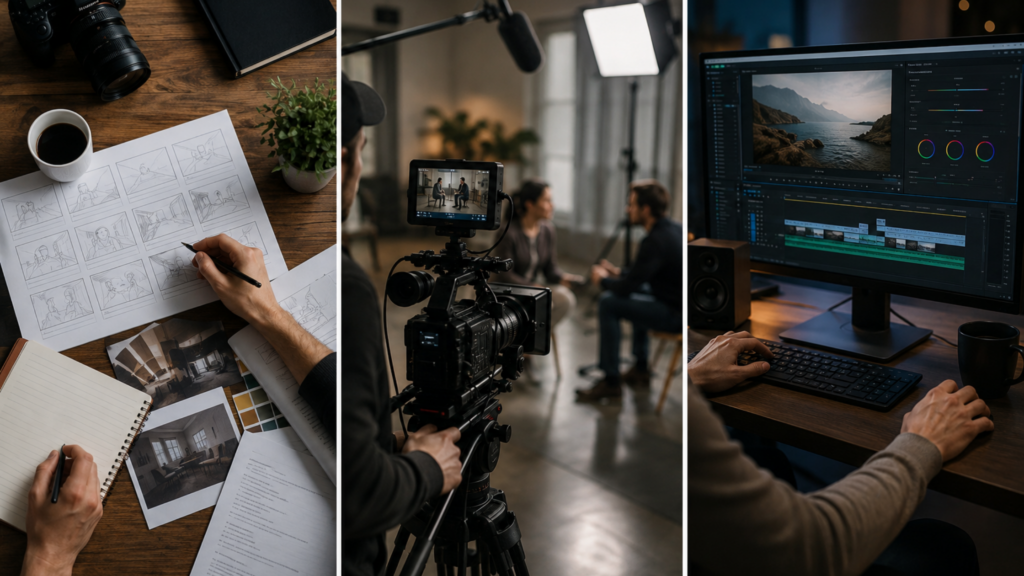
Video is, at its core, an electronic medium for recording and displaying moving images — but professional video production is far more than pressing record. A full-service video production company manages three distinct phases: pre-production, production, and post-production. Understanding all three phases helps you set an accurate budget and avoid scope-creep surprises mid-project.
Pre-Production
Pre-production is everything that happens before a camera turns on. This phase includes scripting, storyboarding, location scouting, casting talent, scheduling the shoot, and securing permits. A well-run pre-production phase can take one to four weeks depending on project complexity. Skipping or rushing it is the single most common reason video projects go over budget.
Production
Production is the actual shoot. The crew captures footage — dialogue, B-roll, interviews, product shots — according to the approved plan. A professional production company owns or rents broadcast-grade cameras, lighting rigs, audio equipment, and stabilizers. Crew size ranges from two people on a simple interview shoot to 20+ on a full commercial production.
Post-Production
Post-production covers video editing, color grading, sound mixing, motion graphics, music licensing, captioning, and final delivery. This phase typically takes two to six weeks and represents 30–50% of the total project budget. Most production companies deliver final files via Vimeo or a secure file-transfer platform, with YouTube-optimized exports available on request.
A video production company manages all three phases under one roof. A solo videographer typically handles only production and basic editing — a meaningful difference when your project requires scripting, animation, or multi-platform delivery.
Learn more: [LINK TO: /blog/video-marketing-strategy] for a deeper look at building a video marketing strategy for brands around your production investment.
Types of Video Production Services and Which One Your Brand Needs
Not every production company specializes in every format. Before you contact vendors, identify which category fits your immediate need. The five main service types are: brand and commercial video, social media and short-form content, explainer and animated video, event videography, and documentary-style storytelling.
Brand and Commercial Video
Brand video is the flagship product of most full-service production companies. This category includes TV spots, hero brand films, product launch videos, and testimonial campaigns. Typical deliverables are a 60–90 second hero cut plus 15- and 30-second edits for paid media. Production budgets for this tier start at $10,000 and commonly reach $50,000–$100,000+ for broadcast-quality work.
Marketing directors use brand videos to anchor campaigns across YouTube, connected TV, and paid social. These projects require the most pre-production investment — detailed scripts, location agreements, professional talent, and multi-day shoots. If you’re building a brand asset meant to last 12–24 months, commercial-tier production is appropriate.
Social Media and Short-Form Video
Short-form video has exploded in demand since Instagram Reels, YouTube Shorts, and TikTok ads became primary brand touchpoints. A professional video production company differs from a solo content creator in this space in three important ways: consistent brand standards, scalable output, and platform-native formatting for multiple aspect ratios (9:16, 1:1, 16:9) delivered in a single shoot.
Production companies that specialize in short-form content typically offer retainer packages — producing 8–20 assets per month — rather than one-off projects. Expect to pay $2,000–$8,000 per month for a managed short-form content program. This model suits brands running always-on paid social campaigns that need fresh creative regularly.
Learn more: [LINK TO: /blog/social-media-video-tips] for short-form video best practices for social media platforms.
For explainer and animated video specifically, see [LINK TO: /blog/explainer-video-guide] to understand how explainer videos work and when animation outperforms live action.
How to Evaluate a Video Production Company: 7 Questions to Ask
Choosing the right vendor requires more than watching their reel. Use these seven questions to separate professional partners from underqualified ones.
1. Does your portfolio include work in my industry or format? A company that has produced healthcare explainer videos understands compliance constraints. One that has shot retail commercials knows how to make products look premium. Relevant experience reduces your risk.
2. What is your typical crew size for a project like mine? A two-person crew is appropriate for a simple talking-head interview. A product launch video needs a director, DP, gaffer, sound operator, and at least one production assistant. Crew size directly affects production quality and day rate costs.
3. Do you own your equipment or rent it? Companies that own broadcast-grade cameras, lenses, and lighting rigs typically have lower day rates and faster availability. Rental-dependent companies aren’t necessarily worse, but rental costs should be itemized in your quote.
4. How many revision rounds are included? Industry standard is two rounds of revisions in post-production. Unlimited revisions is a red flag — it usually means the company hasn’t scoped the project properly and will charge overages later.
5. Who owns the footage and final video? You should own the final edited video and the raw footage after final payment. Confirm this in writing before signing. Some companies retain the raw footage — which limits your ability to repurpose assets later.
6. What is your realistic turnaround time? A straightforward 60-second brand video takes four to eight weeks from kickoff to delivery. Rush timelines cost 25–50% more. Get a written schedule with milestone dates.
7. Can you provide two or three client references? Any reputable production company can connect you with past clients. If they hesitate, walk away.
Learn more: [LINK TO: /services/video-production] to see our video production services and how we approach each of these criteria.
Video Production Pricing: What Does It Actually Cost in 2025?
A video production company typically costs $1,000–$5,000 for a basic small-business video, $5,000–$25,000 for a mid-market brand or commercial video, and $25,000–$100,000+ for a high-end production. Final price depends on crew size, shoot days, location, animation, and post-production complexity.
Here’s how those tiers break down in practice:
| Tier | Budget Range | What You Get |
|---|---|---|
| Budget | $1,000–$5,000 | 1 shoot day, 1–2 person crew, basic editing, 1 deliverable |
| Mid-Market | $5,000–$25,000 | 1–2 shoot days, 4–6 person crew, color grade, music, 2–3 cuts |
| Premium | $25,000–$100,000+ | Multi-day shoot, full crew, animation, broadcast delivery, full asset suite |
The biggest cost driver is crew and shoot days. Each additional shoot day adds $2,000–$8,000 depending on crew size and location. Animation adds $3,000–$15,000 on top of live-action costs. Motion graphics for a 60-second explainer video typically run $5,000–$20,000 as a standalone project.
Hidden Costs to Watch Out For
Several line items commonly appear after a contract is signed. Know them before you negotiate.
Music licensing is one of the most frequently overlooked costs. A commercial music license for a well-known track can cost $500–$10,000+ depending on the song and usage rights. Production music libraries (like Artlist or Musicbed) offer affordable alternatives at $200–$500 per year for unlimited licensing.
Actor and talent fees for SAG-AFTRA talent start at $1,000 per day and increase with usage rights — broadcast usage costs significantly more than digital-only. Non-union talent is cheaper but may not be appropriate for national campaigns.
Location permits in major cities like New York or Los Angeles can run $500–$5,000 per location per day. If your video requires a public space, permit costs must be budgeted in advance.
Color grading is sometimes excluded from base quotes. Professional color grading adds $500–$3,000 to a project and is worth every dollar for brand-facing content.
Caption and subtitle services are increasingly required for accessibility compliance and social media autoplay. Budget $150–$500 per video for professional captioning.
The Video Production Process: A Week-by-Week Timeline
A realistic timeline for a mid-market brand video runs six to ten weeks from kickoff to final delivery. Here’s what each phase looks like in practice.
- Weeks 1–2: Discovery and Pre-Production. The production company reviews your creative brief, asks clarifying questions, and develops a script or shot list. You review and approve. Location scouting and casting happen in parallel.
- Week 3: Pre-Production Finalization. Final script approval, shot list locked, crew scheduled, equipment confirmed, permits secured, talent contracted. Changes after this point increase costs.
- Week 4: Production (Shoot Days). Filming occurs. A one-day shoot for a 60-second brand video is standard at the mid-market tier. Complex productions may require two to three days.
- Weeks 5–6: Post-Production Round 1. The editor assembles a rough cut. Music is selected. You receive a first cut for review — typically 10–14 business days after the shoot.
- Week 7: Revisions. You submit consolidated feedback. The editor delivers a second cut incorporating your notes. This is typically the final revision round included in the base contract.
- Weeks 8–10: Final Delivery. Color grading, sound mixing, captioning, and final export. Files are delivered via Vimeo or a download link in your specified formats.
Broadcast deliveries and animation projects add two to four weeks to this timeline. Build buffer time before your campaign launch date.
Where Your Video Will Live: Distribution Platforms and Format Requirements
Video distribution decisions should be made before the shoot, not after. Where your video lives determines aspect ratio, length, file format, and caption requirements — all of which affect how the production company frames and shoots your content.
- YouTube is the dominant video platform globally, with over 2.7 billion logged-in users per month. Standard delivery format is 16:9 at 1080p or 4K, with a recommended length of 60 seconds to 3 minutes for brand content. YouTube also requires closed captions for accessibility compliance on monetized channels.
- Vimeo is the preferred professional video hosting platform for production companies delivering high-quality client files. It supports up to 8K resolution and is commonly used for portfolio sharing and client review links. Unlike YouTube, Vimeo is ad-free, making it the right home for premium brand content shared with media buyers and agency partners.
- LinkedIn performs best with square (1:1) or vertical (4:5) video under 90 seconds. Captions are essential — 80% of LinkedIn video is watched without sound.
- Instagram Reels and TikTok require vertical 9:16 format at 1080×1920 resolution. Videos between 15 and 60 seconds outperform longer content on both platforms.
- Broadcast TV and connected TV (CTV) require specific technical delivery specs — typically ProRes or MXF files at broadcast color standards. If your video is destined for TV, confirm your production company has broadcast delivery experience before signing.
Brief your vendor on every destination platform on day one. A production company that knows where your video will live can shoot it right the first time.
How to Measure ROI From a Video Production Investment
Video ROI is measurable — but you need to define success metrics before the video launches, not after. Marketing directors should track four core metrics tied to business outcomes.
- View-through rate (VTR) measures what percentage of viewers watched your video to completion. Industry benchmarks vary by platform: 30–45% VTR is strong for a 60-second YouTube pre-roll ad. Low VTR signals a hook problem in the first five seconds.
- Conversion lift is the most direct business metric. Run an A/B test with and without video on a landing page. Studies by Wyzowl (2024) found that 87% of marketers report positive ROI from video — but tracking conversion lift on your specific page gives you your own data point.
- Cost-per-view (CPV) on paid platforms like YouTube averages $0.03–$0.30 depending on targeting and creative quality. A well-produced video with a strong hook consistently outperforms low-quality content in CPV, making production quality a direct cost driver in media spend.
- Brand recall is harder to measure but critical for brand video investments. Use post-campaign surveys (tools like Lucid or Kantar) to measure unaided recall among your target audience. A 10–15% lift in brand recall is a realistic benchmark for a well-distributed brand video campaign.
Tie every video project to at least one of these metrics at the briefing stage. It makes vendor conversations sharper and internal budget approvals easier.
Red Flags: Signs a Video Production Company Isn’t Right for You
Knowing what to avoid is as valuable as knowing what to look for. These warning signs indicate a production partner that may cost you more than their quote.
No written contract. Every professional production engagement requires a signed agreement covering scope, deliverables, timeline, revision rounds, payment schedule, and rights transfer. A company that resists putting terms in writing is a company to avoid immediately.
Vague or unlimited revision policies. “We’ll revise until you’re happy” sounds generous but signals poor project management. It usually means cost overruns or resentment when revisions drag on.
No rights-transfer clause. If the contract doesn’t explicitly state that you own the final video and raw footage upon final payment, you may not legally own what you paid for. This is non-negotiable.
An outdated portfolio. Video production technology and aesthetics move fast. A portfolio with no work from the past two years suggests a company that isn’t actively producing — or isn’t winning competitive projects.
No itemized quote. A lump-sum quote with no line items makes it impossible to understand what you’re paying for or negotiate specific elements. Request a detailed breakdown before signing.
Pressure to skip pre-production. Any company that suggests going straight to the shoot to “save time” is setting up a scope-creep situation. Pre-production protects your budget.
No references or case studies. Established production companies have clients who will vouch for them. If a company can’t provide references, treat that as a serious concern.
Next Steps: How to Brief a Video Production Company Like a Pro
A strong creative brief gets you better work, faster. It aligns your internal stakeholders before the vendor conversation starts and gives production companies the context they need to quote accurately. Use this template as your starting point.
- Objective. What is this video supposed to accomplish? Be specific: “Increase trial sign-ups by 20% on our SaaS landing page” is more useful than “raise brand awareness.”
- Target Audience. Who is watching? Include demographics, platform context, and what they already know about your brand. “Marketing directors at B2B SaaS companies with 50–500 employees who have visited our pricing page” is a useful audience definition.
- Key Message. What is the single most important thing viewers should take away? Limit this to one sentence. If you can’t summarize your message in one sentence, the brief needs more work.
- Tone and Style. Describe the emotional register: professional, warm, urgent, playful? Include three reference videos — from competitors, other industries, or ads you admire — to anchor the visual direction.
- Deliverables. List every format you need: 60-second hero cut, 15-second cutdown, 9:16 vertical version, thumbnail image. The more specific you are, the more accurate your quote will be.
- Deadline. Provide your hard launch date and work backward. Share this date upfront so the production company can assess feasibility before quoting.
- Budget. Share a budget range. Production companies that know your budget can scope the project to fit it. Withholding your budget doesn’t get you a better price — it gets you a mismatched proposal.
Learn more: [LINK TO: /blog/creative-brief-template] to download a free creative brief template you can fill out before your first vendor call.
Glossary
Pre-production: The planning phase of a video project, covering scripting, storyboarding, casting, location scouting, and scheduling — everything that happens before filming begins.
Post-production: The editing phase that follows filming, including video editing, color grading, sound mixing, motion graphics, music licensing, and final file delivery.
Brand video: A professionally produced video designed to communicate a company’s identity, values, or products to a target audience — typically used as a hero asset across paid and owned channels.
Explainer video: A short animated or live-action video (typically 60–90 seconds) that explains a product, service, or concept in simple, visual terms.
Video hosting: The service of storing and streaming video files online. YouTube is the dominant public platform; Vimeo is the preferred professional hosting platform for high-quality brand content and client delivery.
Creative brief: A written document that defines a video project’s objective, audience, key message, tone, deliverables, timeline, and budget — used to align internal stakeholders and brief production vendors.
Short-form video: Video content under 60 seconds, optimized for platform-native formats like Instagram Reels, YouTube Shorts, and TikTok ads.
Music licensing: The legal process of obtaining rights to use a piece of music in a commercial video. Licensing fees vary widely based on the track, usage type, and distribution platform.
Video distribution: The process of publishing and promoting a finished video across platforms — YouTube, LinkedIn, broadcast TV, paid social — to reach a target audience.
Moving images: The foundational element of video — a sequence of still frames displayed rapidly enough to create the perception of motion, as defined by the medium’s technical basis.
FAQ
How much does it cost to hire a video production company?
A video production company costs $1,000–$5,000 for a basic small-business video, $5,000–$25,000 for a mid-market brand film, and $25,000–$100,000+ for premium or broadcast-quality production. Key cost drivers include crew size, number of shoot days, location, animation, and post-production complexity. Always request an itemized quote so you understand exactly what each dollar covers.
What is the difference between a videographer and a video production company?
A videographer is typically one person who shoots and edits video — ideal for events, weddings, or simple interview content. A video production company is a full team with a director, camera operator, lighting crew, sound engineer, and post-production staff. Production companies manage the entire process from scripting to delivery, while a solo videographer handles only the filming and basic editing.
What should I look for in a video production company’s portfolio?
Look for recent work (within the past two years), projects in a similar format or industry to yours, and evidence of quality across all three phases — strong visuals, clean audio, and polished editing. Pay attention to storytelling, not just aesthetics. Also confirm that the portfolio work was actually produced by the company, not a reel of projects from individual team members’ previous employers.
How long does it take a video production company to deliver a finished video?
A standard mid-market brand video takes six to ten weeks from kickoff to final delivery. This includes one to two weeks of pre-production, one to two shoot days, and four to six weeks of post-production including revisions. Rush timelines are possible but typically cost 25–50% more. Build at least two weeks of buffer between your expected delivery date and your campaign launch date.
Who owns the footage and final video after production is complete?
You should own both the final edited video and the raw footage once final payment is made. This must be stated explicitly in your contract as a rights-transfer clause. Some production companies retain raw footage by default — which limits your ability to repurpose assets later. Always negotiate full ownership of all deliverables and raw files before signing.
What types of videos do production companies make for small businesses?
Production companies commonly produce brand overview videos, product demos, customer testimonial videos, social media ads, explainer videos, and event recap videos for small businesses. The most cost-effective starting point for most small businesses is a 60–90 second brand overview video ($2,000–$8,000) that can be repurposed across a website, YouTube, and paid social channels.
How do I write a creative brief for a video production company?
A strong creative brief includes seven elements: your objective (specific business goal), target audience (demographics and platform context), key message (one sentence), tone and style (with reference videos), deliverables (every format you need), hard deadline, and budget range. Sharing your budget upfront helps the production company scope the project accurately and propose the right approach — not the most expensive one.
What platforms should my brand video be optimized for?
Your production company should deliver platform-specific versions for every channel in your distribution plan. YouTube requires 16:9 at 1080p or 4K. LinkedIn performs best with 1:1 or 4:5 square formats under 90 seconds. Instagram Reels and TikTok require vertical 9:16 at 1080×1920. Broadcast and connected TV require ProRes or MXF files at broadcast color standards. Define your distribution plan in your creative brief so the company frames and shoots for every destination from day one.