
A corporate video production agency plans, films, and edits professional video content for businesses — covering everything from brand films and training videos to executive communications and event coverage. These agencies manage the entire production lifecycle, from the first strategy call through final delivery of broadcast-ready files. Hiring the right agency directly affects how well your video performs, how smoothly the project runs, and whether your budget produces measurable results.

Based locally? Our Detroit corporate video production team covers executive messaging, facility films and training video.
What a Corporate Video Production Agency Actually Does
Corporate video production is the process of creating professionally filmed and edited video content that serves a specific business objective. A full-service production company handles strategy, scripting, filming, and post-production under one roof. This differs from a freelance videographer, who typically handles only the camera work and basic editing. Agencies bring structured workflows, dedicated project managers, and access to specialized crews — which is why organizations with larger budgets and higher production standards consistently choose them over solo operators.
Core Services: Pre-Production, Production, and Post-Production
Every professional agency structures its work across three phases.
Pre-production covers everything before the camera rolls: discovery sessions, creative concept development, script development, storyboarding, location scouting, casting, and scheduling. This phase defines your video’s goals, audience, and messaging — and it is where most project failures are prevented.
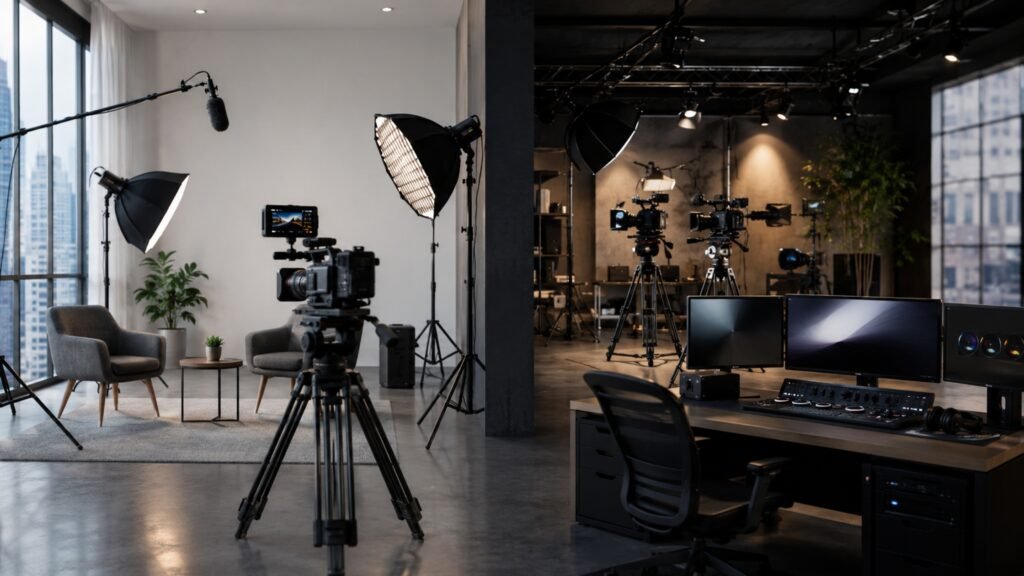
Production is the shoot itself. A full-service agency coordinates directors, camera operators, lighting technicians, sound engineers, and on-screen talent. Multi-camera event coverage requires additional crew and equipment management that a single videographer cannot replicate.
Post-production transforms raw footage into a finished asset. This includes video editing, color grading, motion graphics, voiceover recording, music licensing, and final export in the formats your distribution channels require. Agencies that handle all three phases in-house deliver faster revisions and more consistent quality than those that outsource post-production.
Types of Corporate Videos and When to Use Each
Different business goals call for different video formats. Here is when to use each:
- Promotional video — Used for marketing campaigns, product launches, and brand awareness. Typically 60–90 seconds and designed for digital distribution.
- Internal communications video — Used for company-wide announcements, CEO messages, and culture content. Keeps distributed teams aligned without lengthy meetings.
- Training videos — Used for employee onboarding, compliance education, and skills development. Reduces trainer time and standardizes delivery across locations.
- Multi-camera event coverage — Used for conferences, product reveals, and shareholder meetings. Captures multiple angles simultaneously for highlight reels or full broadcast.
- Testimonial and case study videos — Used for sales enablement and proposal support. Third-party credibility from real customers outperforms brand claims in conversion-stage content.
Browse corporate video examples and portfolio work to identify which format aligns with your current campaign goal before briefing an agency.
How Much Does Corporate Video Production Cost in 2026?
Corporate video production in the US typically costs between $3,000 and $50,000 per finished minute depending on complexity. A basic single-location interview video runs $3,000–$8,000, while a polished multi-location promotional video with motion graphics ranges from $15,000–$50,000. Enterprise training series and broadcast-quality commercials can exceed $100,000.
Here is a practical breakdown by video type:
| Video Type | Typical Budget Range |
|---|---|
| Single-location interview / talking head | $3,000 – $8,000 |
| Internal communications video | $5,000 – $15,000 |
| Promotional brand film (single location) | $10,000 – $25,000 |
| Multi-location promotional video with graphics | $15,000 – $50,000 |
| Training video series (5–10 modules) | $20,000 – $75,000 |
| Broadcast commercial / enterprise campaign | $50,000 – $150,000+ |
Your corporate video budget should account for revision rounds, music licensing, talent fees, and distribution format exports — costs that agencies sometimes list separately in proposals. Review the full video production cost guide for a line-by-line breakdown before requesting quotes.
5 Criteria to Evaluate a Corporate Video Production Agency
Not every agency that produces video produces your kind of video well. Evaluate candidates against these five criteria before shortlisting.
- Portfolio depth in your industry. An agency with ten healthcare case studies understands compliance constraints and clinical messaging. Generic reels are not sufficient evidence of relevant experience.
- Full-service production capability. Confirm that the agency handles pre-production, production, and post-production internally. Agencies that outsource editing introduce communication gaps and slower revision cycles.
- Post-production technology. Ask which editing software, color grading tools, and motion graphics platforms they use. Industry-standard tools (Adobe Premiere Pro, DaVinci Resolve, After Effects) indicate professional-grade output.
- Communication and project management process. A dedicated producer or account manager, milestone-based schedules, and a defined revision policy are non-negotiable on projects above $10,000.
- Rights and licensing clarity. You must own full rights to the finished video and all raw footage. Confirm this in writing before signing any contract.
Explore the full range of video production services to understand what a complete agency engagement typically includes.
Red Flags to Watch for When Reviewing Agency Proposals
Several warning signs in agency proposals indicate risk before a single frame is shot.
Vague deliverables — If the proposal does not specify video length, format, number of revision rounds, and final file types, the agency is leaving room to charge for everything you assume is included.
No revision policy — Unlimited revisions is a red flag, not a benefit. It signals the agency has no defined creative process. A professional agency offers two to three structured revision rounds.
Unclear rights ownership — Some agencies retain rights to raw footage or charge a licensing fee for extended use. If the contract does not explicitly transfer full ownership to you, negotiate before signing.
No named project lead — Proposals that describe a team without naming a dedicated producer mean your project will be passed between staff members without consistent oversight.
Questions to Ask Before Hiring a Corporate Video Agency
Use this checklist during agency evaluation calls:
- Can you share three examples of videos you have produced for companies in our industry?
- Who will be my dedicated point of contact from brief through delivery?
- Do you handle scripting and creative development, or do we need to provide a script?
- What does your revision process look like, and how many rounds are included in this quote?
- Who owns the raw footage after delivery, and can we use it for future projects?
- What is your typical timeline from signed contract to final delivery for this type of video?
- How do you handle scope changes or additional shooting days if the project evolves?
- What file formats and aspect ratios will you deliver, and are social media cuts included?
These questions expose gaps in agency process before they become expensive problems mid-production.
How to Structure Your Brief for a Video Production Agency
A well-structured brief reduces scope creep, speeds up pre-production, and results in stronger creative output. Include the following six elements when briefing any agency:
- Business objective — State the specific outcome the video must achieve. “Increase webinar registrations by 20%” is actionable. “Raise brand awareness” is not.
- Target audience — Describe who will watch the video, including job title, industry, and where they will encounter it (LinkedIn, internal LMS, trade show screen).
- Key messages — List the three to five points the viewer must take away. Prioritize ruthlessly; video cannot carry twenty messages.
- Budget range — Sharing your budget upfront allows the agency to propose the right production tier. Withholding it wastes both parties’ time.
- Timeline and key dates — Identify the launch date and any fixed milestones (board presentation, product launch event) that constrain the schedule.
- Existing assets — List any brand guidelines, existing footage, approved scripts, or product materials the agency can use.
A complete brief typically runs one to two pages. Read the full guide on how to write a video production brief for a downloadable template.
Where to Find and Compare Corporate Video Production Agencies
Three sources consistently surface vetted, reviewed agencies:
Clutch is the most widely used B2B agency directory, featuring verified client reviews, project size filters, and industry specialization tags. Clutch reviews are collected directly from clients, making them more reliable than self-reported case studies on agency websites.
ProductionHub is an industry-standard directory used by production professionals and corporate buyers. It allows filtering by location, production type, and equipment capability — useful when your project requires on-site shooting in a specific market.
Editorial lists from sources like PlayPlay’s corporate video production company roundup provide curated agency recommendations with context on specialization and geographic reach.
When comparing agencies across directories, request itemized proposals from at least three candidates. Comparing line-item quotes — not just total prices — reveals differences in what each agency delivers.

Key Takeaways: Choosing the Right Agency for Your Budget
- Define your objective first. The video format, crew size, and budget all follow from a clear business goal.
- Budget $5,000–$25,000 for most single-video corporate projects. Complex multi-location or series work starts at $25,000 and scales from there.
- Verify full-service capability. Agencies that manage pre-production, production, and post-production internally deliver faster, more consistent results.
- Ask for industry-relevant portfolio samples, not just a general reel.
- Confirm rights ownership in writing before signing any contract.
- Use Clutch and ProductionHub to compare verified agencies rather than relying on cold Google searches.
- Briefly, thoroughly. A detailed brief is the single highest-leverage action a client can take to improve output quality and control costs.
Explore promotional video production options if your immediate priority is a campaign-ready brand or product film.
FAQs
1. How much does corporate video production cost in the US in 2026?
Corporate video production costs range from $3,000 for a basic interview video to $150,000 or more for a broadcast-quality commercial campaign. Most single corporate videos fall between $5,000 and $25,000, depending on crew size, shoot days, and post-production complexity.
2. What is corporate video production and what does it include?
Corporate video production is the professional process of creating video content for business purposes. It includes pre-production (scripting, planning, storyboarding), production (filming), and post-production (editing, color grading, motion graphics, and final delivery). A full-service agency manages all three phases.
3. What should I look for when hiring a corporate video production agency?
Prioritize industry-relevant portfolio experience, in-house post-production capabilities, a defined revision policy, a named project manager, and a contract that transfers full rights to you. Avoid agencies with vague deliverables or unclear ownership terms.
4. What questions should I ask a video production company before signing a contract?
Ask about portfolio examples in your industry, who your dedicated project contact will be, how many revision rounds are included, who owns the raw footage, what the production timeline looks like, and what file formats will be delivered.
5. What is the difference between a promotional video and an internal communications video?
A promotional video is designed for external audiences — customers, prospects, or media — and focuses on brand or product messaging. An internal communications video is produced for employees and focuses on company updates, culture, leadership messages, or policy information.
6. How long does it take to produce a corporate video from brief to delivery?
A straightforward single-location corporate video typically takes three to six weeks from signed contract to final delivery. Complex multi-location productions or series with multiple review stakeholders can take eight to sixteen weeks. Timeline depends heavily on how quickly the client approves the scripts and provides feedback.
7. What deliverables should a corporate video production agency provide?
Standard video deliverables include the finished master video file, compressed versions optimized for web and social media, closed captions or subtitle files, and raw footage (if negotiated). Some agencies also deliver cut-down versions for different platforms as part of the package.
8. How do I write a creative brief for a corporate video production agency?
A strong creative brief includes your business objectives, target audience description, key messages, budget range, launch timeline, and any existing brand assets. Keep it to one or two pages. A specific, goal-oriented brief reduces revision cycles and produces stronger creative output than a vague concept overview.