Brand video production is the end-to-end process of planning, filming, and editing video content that communicates a company’s identity, values, and story — rather than promoting a specific product. It spans five phases: discovery, pre-production, production, post-production, and distribution, and is used primarily to build long-term brand awareness and emotional connection with target audiences.
What Is Brand Video Production?
Brand video production is the structured process of creating video content that expresses who a company is, what it stands for, and why it exists — not just what it sells. That distinction matters. A product demo shows features. An explainer video teaches a process. A commercial drives immediate purchase. A brand video builds lasting identity.
According to Wyzowl’s 2024 State of Video Marketing report, 89% of businesses use video as a marketing tool, and brand-level video content consistently ranks among the highest for long-term audience retention and recall. Brand videos typically live on homepages, pitch decks, and social channels — anywhere a first impression is made.
Featured snippet answer: Brand video production is the end-to-end process of planning, filming, and editing video content that communicates a company’s identity, values, and story — rather than promoting a specific product. It typically spans five phases: discovery, pre-production, production, post-production, and distribution, and is used primarily to build long-term brand awareness.
The key differentiator is intent. A commercial asks viewers to act now. A brand video asks viewers to believe — in the company’s mission, culture, or promise. That shift in intent changes everything: the script, the visuals, the music, the metrics, and the distribution strategy.
Types of Brand Videos and When to Use Each
Not every brand video serves the same purpose. Choosing the right format before production begins saves budget and produces better results. Here are the five core formats and their primary use cases.
Brand Story Videos
A brand story video communicates a company’s origin, mission, and values through narrative. It is the flagship brand video format — the one that lives on your homepage and opens your investor deck.
Ideal length is 60–90 seconds. Google and YouTube’s creative best practices confirm that videos under 90 seconds retain viewer attention significantly better than longer formats when the primary goal is brand recall rather than education. Structure the narrative in three beats: the problem your company was founded to solve, how you solve it, and the world you’re building toward.
Brand story videos work best at the top of the funnel, where audiences are meeting your company for the first time. Place them on your homepage hero section, your LinkedIn company page, and in paid YouTube pre-roll campaigns targeting cold audiences. A strong brand storytelling strategy starts with this format before any others.
Testimonial and Case Study Videos
Testimonial and case study videos place real customers on camera to describe the transformation your product or service delivered. They are conversion-stage assets — most effective when a prospect already knows who you are and needs social proof to move forward.
A strong testimonial video checklist includes:
- One specific result — a number, a timeline, or a named outcome (not “it was great”)
- A relatable protagonist — a customer who mirrors your target buyer’s role, industry, or pain point
- Conflict before resolution — describe the problem clearly before the solution
- Unscripted language — coach, don’t script; authenticity drives trust
- B-roll of the customer in context — at their desk, in their facility, using your product
Wyzowl data shows that 79% of people say a brand’s video has convinced them to buy a software or app. Testimonial videos are the format most directly tied to that conversion moment.
The Brand Video Production Process: 5 Phases
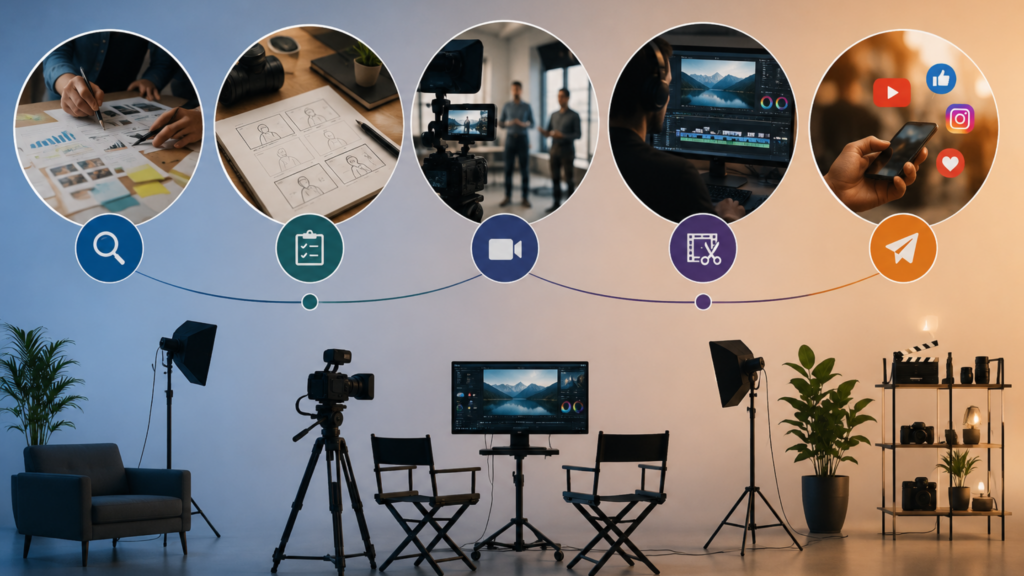
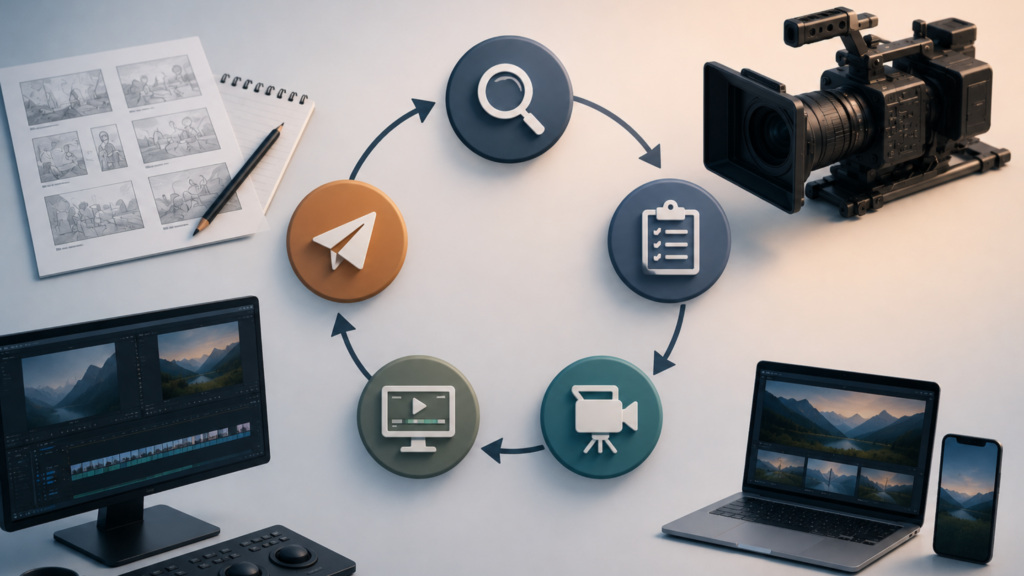
Professional brand video production follows five sequential phases. Skipping any one of them is the most common cause of cost overruns and misaligned final products.
- Discovery — Define business goals, target audience, key message, and success metrics. This phase produces a creative brief.
- Pre-Production — Develop the script, storyboard, shot list, casting plan, location scouting, and production schedule.
- Production — Execute the shoot. This is typically the shortest phase in calendar time but the highest in day-rate cost.
- Post-Production — Edit footage, add motion graphics, color grade, mix audio, and incorporate licensed music and voiceover.
- Distribution — Format the final video for each platform, schedule releases, and set up paid amplification where applicable.
Pre-Production: Creative Brief and Scripting
The creative brief is the single most important document in brand video production. A weak brief produces a video that looks good but says nothing. A strong brief aligns the entire production team before a single frame is shot.
A production-ready creative brief should include:
- Project overview — one paragraph describing the video’s purpose and business goal
- Target audience — demographics, psychographics, and the platform where they’ll watch
- Core message — the single idea the viewer must leave with
- Tone and style — three adjectives, plus two reference videos that reflect the desired feel
- Deliverables — aspect ratios, lengths, and platform specs (e.g., 16:9 for YouTube, 9:16 for Instagram Reels)
- Budget and timeline — approved spend and key milestone dates
- Approval workflow — who reviews, who approves, and how many revision rounds are included
For a deeper walkthrough, see our guide on how to write a video creative brief.
Brand Video Production Costs: 2025 Benchmarks
Brand video production cost varies widely based on crew size, shoot days, location, and post-production complexity. Here are realistic 2025 benchmarks by tier.
| Production Tier | Cost Range (per finished video) | What You Get |
|---|---|---|
| DIY / Low-Budget | $500–$5,000 | Smartphone or mirrorless camera, minimal crew, basic edit |
| Mid-Market Agency | $10,000–$50,000 | Professional crew, 1–2 shoot days, full post-production |
| Premium Production House | $75,000–$250,000+ | Director, DP, multi-day shoot, broadcast-grade post |
A single 60-second brand story video from a mid-market video production agency typically costs between $15,000 and $35,000 in 2025. Testimonial videos run $5,000–$15,000 per story depending on travel and complexity. Social brand films optimized for paid distribution often sit between $8,000 and $20,000.
IAB’s video advertising spend data confirms that brand video investment is growing across all company sizes, with small and mid-size businesses increasing production budgets by an average of 18% year-over-year. For a full breakdown, see our video production cost breakdown.
In-House vs. Agency vs. Hybrid: Choosing Your Model
Each production model has real trade-offs. Use this decision matrix to match your situation.
| Factor | In-House | Agency | Hybrid |
|---|---|---|---|
| Control | High | Medium | High |
| Cost | Low–Medium | Medium–High | Medium |
| Speed | Fast (reactive) | Slower (process) | Moderate |
| Production Quality | Variable | Consistent | Consistent |
| Best For | High-volume social content | Hero brand films, campaigns | Ongoing content + annual hero video |
In-house teams excel at speed and volume — daily social content, internal comms, and reactive culture moments. Agencies deliver consistency and craft for high-stakes brand films where quality directly affects perception. A hybrid model — agency for annual hero videos, in-house for always-on content — is the approach most marketing directors at mid-size companies are adopting in 2025.
The right model depends on three variables: how often you need video, how high the production quality bar is, and whether you have internal creative leadership to direct an agency effectively.
How to Brief a Brand Video Production Agency
A clear brief reduces revision cycles, protects your budget, and produces better creative work. Follow these six steps when briefing a video production agency.
- State the business goal first — not “we want a brand video” but “we want to reduce bounce rate on our homepage by 20% and increase demo requests.”
- Define the audience precisely — job title, industry, pain point, and where they’ll watch the video.
- Specify the tone — share three adjective descriptors and two reference videos.
- List all deliverables upfront — include every cut length and aspect ratio you need before the shoot, not after.
- Set the approval workflow in writing — name the decision-maker, number of revision rounds, and turnaround time for feedback.
- Confirm rights and usage — clarify ownership of raw footage, music licensing, and talent usage rights before signing.
Agencies fail to deliver not because they lack skill — they fail because the brief was incomplete. Every hour spent on the brief saves three hours in revisions.
Measuring Brand Video ROI: Metrics That Matter
Marketing directors justifying brand video budgets need more than view counts. Four KPIs connect brand video performance to business outcomes.
View-through rate (VTR) measures the percentage of viewers who watch to completion. Industry benchmarks average 25–30% for 60-second videos on YouTube. A VTR above 35% signals strong creative-audience alignment.
Brand lift measures the change in awareness, favorability, or purchase intent among exposed audiences versus a control group. Nielsen’s brand lift methodology is the industry standard for quantifying this impact, and both Google and Meta offer in-platform brand lift studies for campaigns spending above threshold minimums.
Share rate measures organic amplification — the percentage of viewers who share the video without paid incentive. A share rate above 1% is considered strong for brand content.
Assisted conversion tracks how often a brand video appeared in a buyer’s journey before a conversion event, even if it wasn’t the last touchpoint. Connect YouTube Analytics or LinkedIn video data to your CRM to surface this. For a full framework, see our guide on measuring video marketing ROI.
Distributing Brand Videos for Maximum Reach in 2025
Production without distribution is waste. Plan your video distribution strategy before the shoot, not after.
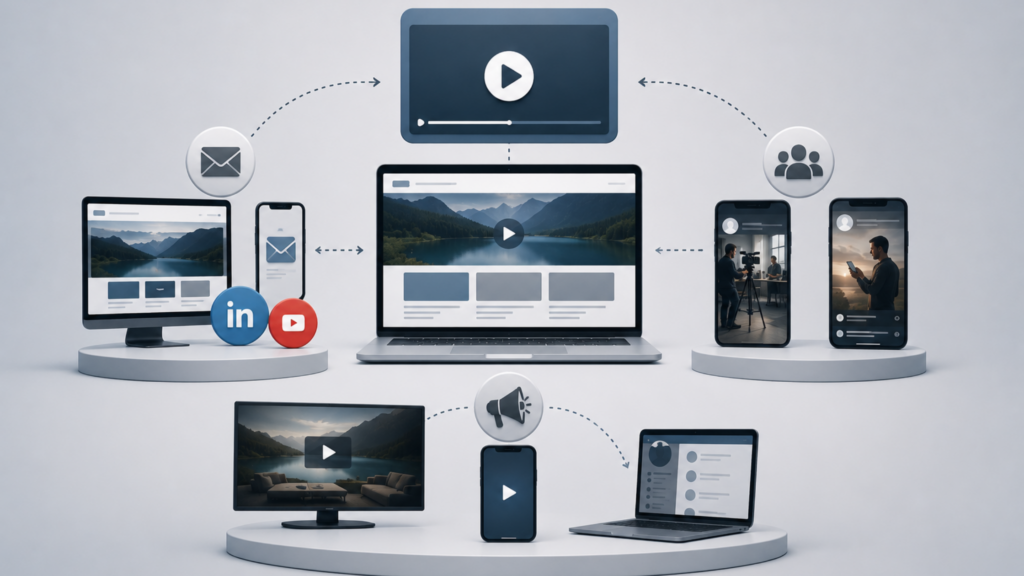
Owned channels: Embed the hero video on your homepage above the fold. Include a 30-second cut in your email welcome sequence. Add the full version to your LinkedIn company page and YouTube channel with a keyword-optimized description.
Earned channels: Pitch the brand story video to trade press as a story asset. Share behind-the-scenes content on organic social to extend shelf life. Encourage employees to share culture videos on their personal LinkedIn profiles — LinkedIn’s own data shows employee-shared content receives 2x higher engagement than brand page posts.
Paid channels: Run 15-second and 30-second cuts as YouTube advertising pre-roll against competitor keyword targeting. Activate LinkedIn video ads for B2B audiences using job title and company size targeting. Invest in connected TV (CTV) placements for brand awareness campaigns targeting household-level audiences — IAB reports CTV ad spend exceeded $25 billion in 2024 and continues to grow.
Format specifications matter. For social media video format specifications, export 16:9 for YouTube and LinkedIn feed, 1:1 for Instagram feed, and 9:16 for Instagram Reels, TikTok, and YouTube Shorts.
Key Takeaways and Next Steps
Brand video production is a strategic investment, not a one-time creative exercise. Here’s the decision framework in brief:
- Define the goal before the format — brand awareness, conversion, or recruitment each require different video types and distribution channels.
- Budget realistically — a mid-market brand story video costs $15,000–$35,000; plan for distribution spend equal to at least 30% of production cost.
- Choose your production model deliberately — in-house for volume, agency for craft, hybrid for both.
- Brief thoroughly — a complete creative brief with goals, audience, tone, deliverables, and approval workflow is the single biggest predictor of project success.
- Measure what matters — view-through rate, brand lift, share rate, and assisted conversion connect video performance to real business outcomes.
If you’re ready to start planning your brand video, the first step is a documented brand storytelling strategy that defines your core message before any production begins. From there, a qualified video production agency can translate that strategy into content that builds awareness, earns trust, and drives measurable results.
Frequently Asked Questions
How much does brand video production cost?
Brand video production costs range from $500–$5,000 for DIY low-budget projects to $10,000–$50,000 for a mid-market agency and $75,000–$250,000+ for premium production houses. A typical 60-second brand story video from a professional agency costs between $15,000 and $35,000 in 2025, depending on crew size, shoot days, and post-production complexity.
What is the difference between a brand video and a commercial?
A commercial is designed to drive immediate action — a purchase, a click, or a call. A brand video is designed to build identity and emotional connection over time. Commercials are product-focused and short (6–30 seconds). Brand videos are story-focused and typically run 60–180 seconds. Both can run as paid ads, but their creative goals are fundamentally different.
How long should a brand video be?
A brand story video should be 60–90 seconds for homepage and social use. Testimonial videos perform well at 90–120 seconds. Social brand films cut for paid distribution work best at 15–30 seconds. Google and YouTube’s creative best practices confirm that videos under 90 seconds retain significantly more viewer attention when the goal is brand recall.
What should be included in a video production creative brief?
A complete creative brief should include: the business goal, target audience description, core message, tone and style references, all deliverable specifications (lengths and aspect ratios), approved budget, key milestone dates, and the approval workflow with named decision-makers and revision round limits.
How do I measure the ROI of a brand video?
Measure brand video ROI using four KPIs: view-through rate (completion percentage), brand lift (change in awareness or purchase intent measured via a study), share rate (organic amplification), and assisted conversion (how often the video appeared in a buyer’s path before a conversion). Connect video analytics platforms to your CRM to track the last metric accurately.
Should I hire a video production agency or produce videos in-house?
Hire an agency for high-stakes brand films where quality directly affects perception — homepage hero videos, campaign launches, and investor content. Build in-house capability for high-volume, always-on social content. A hybrid model works best for most mid-size companies: agency for annual hero videos, in-house for ongoing content.
What types of brand videos drive the most awareness?
Brand story videos and manifesto videos drive the highest brand awareness because they communicate identity and values at scale. Wyzowl’s research consistently shows that emotionally driven brand content outperforms product-focused video on recall and shareability metrics. For paid awareness campaigns, 15–30 second social brand films distributed via YouTube pre-roll and connected TV (CTV) deliver the broadest reach.
How long does brand video production take from brief to delivery?
A typical brand video production timeline runs 6–12 weeks from signed brief to final delivery. Discovery and pre-production take 2–3 weeks. The shoot itself is 1–2 days. Post-production — editing, color grading, audio mix, and revisions — takes 3–5 weeks. Rush timelines are possible but typically add 20–30% to the total production cost.